| Latin Name |
Gyps africanus |
| Conservation Status |
Endangered |
| Location
| Africa |
| Colour |
Grey & White |
| Length |
94 cms (37 inches) |
| Wingspan |
1.96 - 2.25 m (6.4 - 7.4 ft) |
| Weight |
4 - 7 Kgs (8.75 - 15 lbs) |
| Life Expectancy |
- Yrs |
Main Characteristics
The African White-Backed Vulture is an old world vulture. They have a body length of approximately 94 cms (37 inches), a wingspan between 1.96 and 2.25 m (6.4 - 7.4 ft) and they weigh between 4 and 7 kgs (8.75 - 15 lbs).
They have a grey neck with a collar of white feathers at the top of their back and their other plumage is various shades of grey. They have large, broad wings which enable them to soar and circle on thermals for hours looking for food.
Habitat
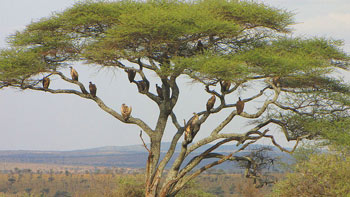
African White-Backed Vultures can be found in sub-Saharan Africa. They live in groups in open habitats such as plains and savannahs.
Diet
African White-Backed Vultures feed on carrion. They are legendary for their ability to find food. Their sense of smell is poor but they have extremely good eyesight, enabling them to spot dead remains from high in the air. They also keep an eye on each other and if one bird sees food and makes a sudden descent, others will quickly follow.
Breeding
African White-Backed Vultures breed during the dry season. The female lays 1 egg and it is incubated for approximately 43 days.
Predators
African White-Backed Vultures have no natural predators, except humans.
Subspecies
There are no subspecies of the African White-Backed Vulture.
Interesting Facts
African White-Backed Vultures are also known as:
White-Backed Vulture
The African White-Backed Vulture is one of a group of 8 species which have long necks that appear to be bald, but that are actually covered in a fine down. This absence of neck feathers allows the vulture to reach deep into a carcass without becoming dirty.
|