| Latin Name |
Gyps rueppellii |
| Conservation Status |
Endangered |
| Location
| Africa |
| Colour |
Brown or Black |
| Length |
Approx. 1 m (3.3 ft) |
| Wingspan |
Approx. 2.6 m (8.5 ft) |
| Weight |
7 - 9 Kgs (15 - 20 lbs) |
| Life Expectancy |
40 - 50 Yrs |
Main Characteristics
Rüppell's Vultures are a large species of vulture with a length of approximately 1 m (3.3 inches), a wingspan of approximately 2.6 m (8.5 ft) and they weigh between 7 and 9 kgs (15 - 20 lbs).
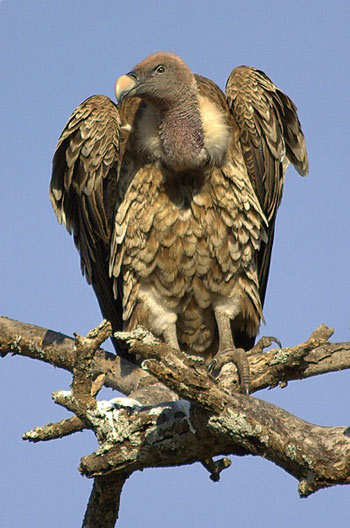
Their plumage is mottled brown or black with a pale brown underside and pale coloured fluff covering their head and neck. At the base of their neck they have a white collar and their crop patch is deep brown.
Their eyes are coloured yellow or amber and they have excellent eyesight. They locate their food solely by using their sense of vision and when they have found a carcass they circle overhead alerting other vultures to their find. Their beak is extremely powerful and they have backward facing spines on their tongue to assist them while feeding.
Rüppell's Vultures have a cruising speed of 35 km/hr (22 mph) and it is not uncommon for them to reach heights of 6,000 m (20,000 ft) while flying. They hold the record for being the highest flying bird as on one occasion a Rüppell's Vulture collided with an aircraft over the Côte d'Ivoire at an altitude of 11,300 m (37,000 ft).
They are generally silent birds but they make squealing sounds when at their nest or at a carcass.
Habitat
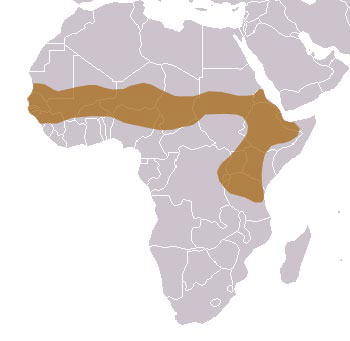
Rüppell's Vultures are found in the open woodlands, grasslands and montane regions of Africa. They are highly social birds and they roost, nest and feed in large flocks. They tend to roost on inaccessible rock ledges or in Acacia trees.
Diet
Rüppell's Vultures are scavengers and they feed on the carcasses of dead animals. They do not supplement their diet with living prey, therefore they sometimes have to travel great distances to find food. If required they will travel up to 150 kms (93 miles) from their nest site to locate a carcass.
Vultures feeding habits play an important role in nature as they clear up a carcass that otherwise would be left to rot. A group of vultures can clear up the remains of an antelope in 20 minutes.
Breeding
Rüppell's Vultures form breeding colonies consisting of up to 1,000 breeding pairs. They pair up for life and depending on the location of the nest, they may use it year after year or only once.
The pair construct a large nest from sticks and they line it with grass and leaves. One egg is laid and both parents share incubation duties for approximately 55 days. Upon hatching both parents take care of the chick and the youngster fledges at 12 weeks and becomes independent by the beginning of the next breeding cycle the following year.
Predators
The main predator of Rüppell's Vultures are humans.
Subspecies
There are two subspecies of Rüppell's Vulture:
Gyps rueppellii erlangeri
Gyps rueppellii rueppellii
Interesting Facts
Rüppell's Vultures are also known as:
Rüppell's Griffon
Rueppell's Vulture
Rüppell's Griffon Vulture
Rüppell's Vulture was named in honour of the 19th centaury German explorer, collector and zoologist Eduard Rüppell.
Rüppell's Vulture hold the record for the highest avian flight.
Rüppell's Vulture is one of a group of 8 species which have long necks that appear to be bald, but that are actually covered in a fine down. This absence of neck feathers allows the vulture to reach deep into a carcass without becoming dirty.
|