| Latin Name |
Phoenicoparrus andinus |
| Conservation Status |
Vulnerable |
| Location
| South America |
| Colour |
Pinkish/White |
| Height |
1 - 1.4 m (3.25 - 4.60 ft) |
| Wingspan |
1 - 1.6 m (3.25 - 5.25 ft) |
| Weight |
Up to 4 Kgs (8.8 lbs) |
| Life Expectancy |
Up to 40 Yrs |
Main Characteristics
Andean flamingos reach heights between 1 and 1.4 m (3.25 - 4.60 ft), they have a wingspan between 1 and 1.6 m (3.25 - 5.25 ft) and they weigh up to 4 kgs (8.8 lbs).
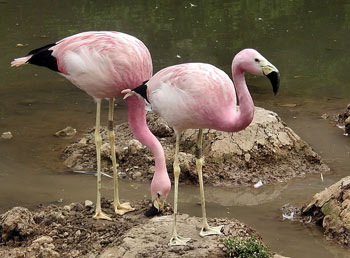
They are light pink in colour with their head, neck and upper breast being darker. As young birds they are grey in colour but their plumage slowly turns pink as they mature. Their long, thin legs and feet are yellow in colour and their large, downward curving bill is yellow with an extensive black tip.
Andean Flamingos have a loud honking call that is similar to that of a goose they also communicate using a wing salute, stretching up their neck and flipping up their tail.
Habitat
Andean Flamingos are found in the lakes and lagoons of the Andes mountains. They are highly gregarious birds and form flocks containing thousands of individuals.
Diet
Andean Flamingos are filter feeders and they mainly feed upon diatoms and algae.
Breeding
Andean Flamingos breed in colonies containing thousands of individuals, during December and January. They produce one chalky white egg that is laid on a mud mound in shallow water. Both parents incubate the egg which takes 27 - 31 days to hatch.
Upon hatching the chicks are covered in white/grey down feathers and they are fed a substance called "crop milk" which comes from the parents' upper digestive tract. Either parent can feed the chick this way and other flamingos can act as foster feeders. When the chicks are old enough to walk they gather together in creches that are watched over by a few adult birds.
By the time young flamingos reach 6 - 10 months old they are ready to fend for themselves and at 3 - 6 years old they will have reached sexual maturity and gained their full adult plumage.
Predators
Andean Flamingos do not have many predators. Chicks are preyed upon by culpeo foxes and birds of prey.
Subspecies
There are no subspecies of the Andean Flamingo.
Interesting Facts
The Andean Flamingo is closely related to the Puna Flamingo.
Flamingo comes from the latin word for flame.
The flamingo's characteristic pink colouring is caused by the beta carotene in their diet.
Similar Birds
Caribbean Flamingo
Chilean Flamingo
Greater Flamingo
Lesser Flamingo
Puna Flamingo
|

 Andean Flamingo Range Map (South America)