| Latin Name |
Genetta genetta |
| Conservation Status |
Least Concern |
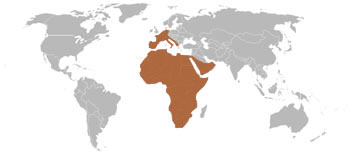
| Location
| Africa, W Europe & Middle East |
| Colour |
Yellowish/Grey with Black markings |
| Length |
40 - 55 cms (16 - 22 inches) |
| Tail |
40 - 51 cms (16 - 20 inches) |
| Weight |
1.5 - 2.5 Kgs (3.25 - 5.5 lbs) |
| Life Expectancy |
13 Yrs |
Main Characteristics
Common Genets have a body length between 40 and 55 cms (16 - 22 inches), a tail length between 40 and 51 cms (16 - 20 inches) and they weigh between 1.5 and 2.5 kgs (3.25 - 5.5 lbs).
They are yellowish/grey in colour with small, dark spots on their body and stripes on their tail. They have retractable claws and they are excellent climbers.
Habitat
Common Genets are the most widespread species of genet and they can be found in forested areas of Europe, Africa and in parts of the middle east. They are solitary and nocturnal.
Diet
Common Genets feed on a variety of small mammals, birds, lizards, amphibians, insects, fruits and eggs.
Breeding
After a gestation period of 70 days, a litter of 2 - 3 young are born. They are weaned at 8 weeks old and reach sexual maturity at 2 years of age.
Predators
Predators of Common Genets include owls, snakes and leopards.
Subspecies
Many subspecies of the Common Genet have been described, but many are under debate as to their validity. The subspecies include:
Genetta genetta afra
Genetta genetta dongolana
Genetta genetta felina
Genetta genetta genetta
Genetta genetta senegalensis
Interesting Facts
Common Genets are also known as:
Small-Spotted Genet
European Genet
Similar Animals
Angolan Genet
Panther Genet
Giant Genet
Aquatic Genet
Large-Spotted Genet
Servaline Genet
Thierry's Genet
Abyssinian Genet
|