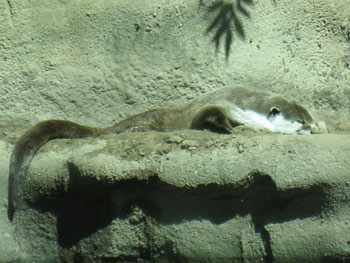
| Latin Name |
Aonyx capensis |
| Conservation Status |
Least Concern |
| Location
| Africa |
| Colour |
Brown |
| Length |
73 - 95 cms (29 - 37 inches) |
| Tail |
41 - 67 cms (16 - 26 inches) |
| Weight |
10 - 16 Kgs (22 - 35 lbs) |
| Life Expectancy |
Up to 11 Yrs (in Captivity) |
Main Characteristics
African Clawless Otters have a body length between 73 and 95 cms (29 - 37 inches), a tail length between 41 and 67 cms (16 - 26 inches) and they weigh between 10 and 16 kgs (22 - 35 lbs). They are brown in colour with thick, smooth fur.
Habitat
African Clawless Otters live in a variety of habitats in Africa.
Diet
African Clawless Otters mainly feed on fish, frogs, crabs and worms.
Breeding
After a gestation period of approximately 63 days, African Clawless Otters give birth to a litter of 2 - 3 young. They are weaned at 45 - 60 days and are fully mature at a year old.
Predators
Predators of the African Clawless Otter include pythons, crocodiles and fish eagles.
Subspecies
Subspecies of the African Clawless Otter include:
Aonyx capensis capensis
Aonyx capensis hindei
Aonyx capensis meneleki
Interesting Facts
The African Clawless Otter is also known as:
Cape Clawless Otter
Groot Otter
African Clawless Otters are the second largest species of freshwater otter.
Similar Animals
Congo Clawless Otter
Smooth-Coated Otter
Spotted-Necked Otter
Oriental Small-Clawed Otter
European Otter
Hairy-Nosed Otter
Giant Otter
Sea Otter
|