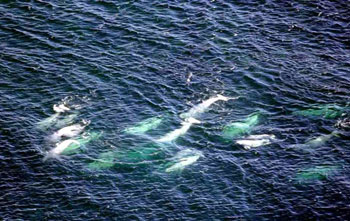
Belugas are between 4 and 5 m (13 - 16.5 ft) in length and they weigh up to 1.5 tonnes (1.5 tons). As calves they are grey in colour but as they age they develop their distinctive white colouration.
They have a large, bulbous melon and a short beak. Unlike many other cetacean species they have the ability to move their head laterally and up and down.
Belugas are very vocal and they make a range of different sounds including clicks, chirps and trills.
Habitat
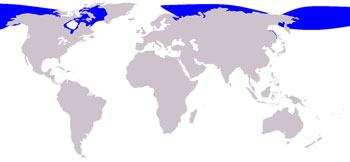
Belugas are found in the coastal areas of the Arctic Ocean and adjoining seas.
Diet
Belugas feed on a variety of fish, octopus, squid and crustaceans.
Breeding
After a gestation period of 14 months a single calf is born. They are weaned at 12 - 24 months old. Females reach sexual maturity at 4 - 7 years and they reproduce every 2 - 3 years until they are in their early 20s. Males reach sexual maturity at 7 - 9 years of age.
To watch a video of a Beluga giving birth Continue>