| Latin Name |
Balaenoptera musculus |
| Conservation Status |
Endangered |
| Location
| Worldwide |
| Colour |
Pale Blue/Grey |
| Length |
20 - 30 m (66 - 98 ft) |
| Weight |
100 - 160 tonnes
(98.5 - 157.5 tons) |
| Life Expectancy |
Approx. 110 Yrs |
Main Characteristics
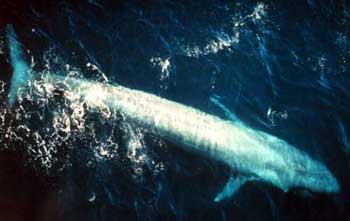
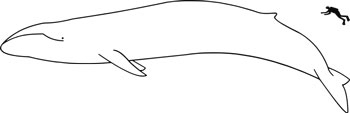
Blue Whales are the largest animal in the world. They reach lengths between 20 and 30 m (66 - 98 ft) and they weigh between 100 and 160 tonnes (98.5 - 157.5 tons).
They have long, tapering bodies and a flat, u-shaped head that has a prominent ridge running from the blow hole to the top of the upper lip. From their top lip hang approximately 300 baleen plates that are around 1m (3.3 ft) long and they run approximately 0.5 m (1.6 ft) back into their mouth. These plates assist the whale with removing water from its mouth after feeding.
The tongue of a Blue Whale weighs around 2.7 tonnes (2.66 tons) and when their mouth is fully expanded it can hold up to 90 tonnes (88.6 tons) of food and water. Despite the size of their mouth, their throat dimensions will not allow them to swallow anything larger than the size of a beach ball.
Blue Whales have a small dorsal fin located about three quarters of they way along their back and they have flippers that are 3 - 4 m (10 - 13 ft) in length. They also have 55 - 68 skin grooves or pleats that are located on their underside and they run from their jaw to approximately half way along their body. They are coloured blue/grey on their upper surface, with a mottled pattern, and are paler on their underside.
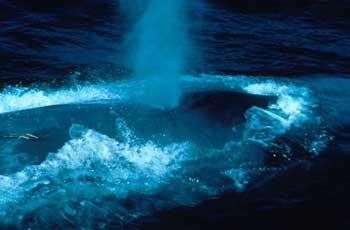
They have twin blowholes that are shielded by a large splash guard and when they return to the surface after a dive they will release a "blow", consisting of warm air, mucus and water, about 9m (30 ft) high into the air.
Blue Whales can dive to depths of 200 m (655 ft) and when making a deep dive they will "headstand" exposing their distinctive tail flukes above the surface of the water. They will descend steeply, using propulsion from their back muscles that moves their rear body and tail flukes up and down.
Blue Whales make the loudest noise of any creature. They make grunts, hums and moans that can reach volumes greater than 180 decibels.
They generally swim slowly but they can reach speeds of 30 Km/h (18.6 mph) if required.
Habitat
Blue Whales are found in oceans throughout the world except in the Mediterranean Sea, Baltic Sea, Red Sea and the Arabian Gulf.
They tend to be solitary except mothers with their young or sometimes they will live in small pods consisting of 2 - 3 individuals.
Diet
The diet of a Blue Whale mainly consists of krill and they can eat up to 3,600 Kgs (8,000 lbs) in a single day. They typically feed at depths of more than 100 m (330 ft) during the day and feed on the surface at night.
They feed by lunging forwards at groups of krill, taking the animals and large quantities of water in their mouth. They then squeeze out the water through their baleen plates and once their mouth is clear from water, they swallow the remaining krill.
Breeding
Blue Whales start mating in late autumn and continue until the end of winter. After a gestation period of 10 - 12 months females give birth to one calf at the start of the winter months.
At birth the calf is approximately 7 m (23 ft) in length and it weighs approximately 2.5 tonnes (2.46 tons) - the same weight as a fully grown hippopotamus. The calf is nursed for 6 - 8 months and it drinks 380 - 570 litres of milk per day.
Blue Whales reach sexual maturity between 5 - 10 years old.
Predators
The main predators of young Blue Whales are killer whales. Blue Whales were hunted by man until they were declared a protected species in 1966.
Subspecies
The subspecies of a Blue Whales includes:
Northern Blue Whale
(Balaenoptera musculus musculus)
They inhabit the north Atlantic and the north Pacific oceans.
Southern Blue Whale
(Balaenoptera musculus intermedia)
They inhabit the Southern ocean
Pygmy Blue Whale
(Balaenoptera musculus brevicauda)
They inhabit the Indian ocean and the south Pacific.
Interesting Facts
Blue Whales are the largest animal in the world.
Blue Whales are also known as:
Sibbald's Rorqual
Great Blue Whale
Great Northern Rorqual
Sulphur Bottom - called this by Herman Melville in his book Moby Dick
Watch an amazing video of a baby Blue Whale. Continue> 
Similar Animals
Fin Whale
Sei Whale
Omura's Whale
Bryde's Whale
Pygmy Bryde's Whale
Common Minke Whale
Antarctic Minke Whale
Humpback Whale
|
|