| Latin Name |
Sylvilagus audubonii |
| Conservation Status |
Least Concern |
| Location
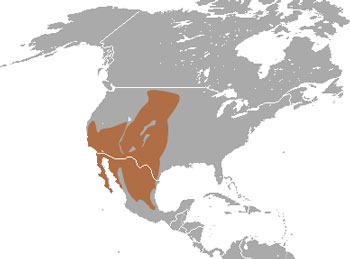
| North & Central America |
| Colour |
Light Grey/Brown |
| Length |
33 - 43 cms (13 - 17 inches) |
| Tail |
- |
| Weight |
Up to 1.5 Kgs (3.25 lbs) |
| Life Expectancy |
Up to 3 Yrs |
Main Characteristics
Desert Cottontails have a body length between 33 and 43 cms (13 - 17 inches) and they weigh up to 1.5 kgs (3.25 lbs). They are light grey/brown in colour with a pale coloured underside. Their ears are 8 - 10 cms (3 - 4 inches) in length and their tail is rounded and coloured white underneath.
Desert Cottontails can run at speeds of 24 km/hr (15 mph) and they are more agile than other cottontails, as they are able to swim and climb trees and piles of brush.
Habitat
Desert Cottontails can be found in the arid areas, grasslands and woodlands of south western North America to central Mexico. They occupy a home range of approximately 8 acres and they are mainly active at dawn and dusk, spending the rest of their time under cover.
Diet
Desert Cottontails mainly feed on a variety of grasses, but they will also eat fruit, vegetables and nuts.
Breeding
Desert Cottontails breed from January to September and they can have up to 5 litters per year. After a gestation period of 26 - 30 days, they will give birth to an average of 3 young, but they can have up to 5 young per litter.
At birth the young rabbits weigh approximately 34 g (1.2 oz) and they are blind and hairless. They rapidly grow and by the time they are 10 days old they can open their eyes. They can leave the nest at 14 days old and they are weaned at 21 - 28 days old.
Desert Cottontails reach sexual maturity at 3 months old.
Predators
Predators of Desert Cottontails include humans, foxes, coyotes, bobcats, mustelids, owls and birds of prey.
Subspecies
Subspecies of the Desert Cottontail are:
Sylvilagus audubonii arizonae
Sylvilagus audubonii audubonii
Sylvilagus audubonii baileyi
Sylvilagus audubonii confinis
Sylvilagus audubonii goldmani
Sylvilagus audubonii minor
Sylvilagus audubonii vallicola
Sylvilagus audubonii sanctidiegi
Sylvilagus audubonii parvulus
Sylvilagus audubonii cedrophilus
Sylvilagus audubonii neomexicanus
Interesting Facts
Desert Cottontails are also known as:
Audubon's Cottontail
Similar Animals
New England Cottontail
Mexican Cottontail
Eastern Cottontail
Robust Cottontail
Appalachian Cottontail
Marsh Rabbit
Swamp Rabbit
Venezuelan Lowland Rabbit
|
|