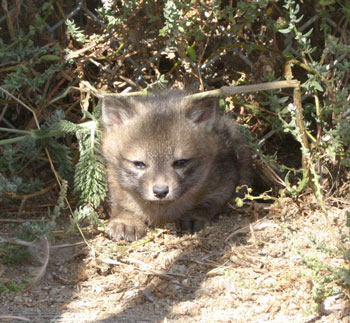
| Latin Name |
Urocyon littoralis |
| Conservation Status |
Critically Endangered |
| Location
| USA |
| Colour |
Grey |
| Length |
48 - 50 cms (19 - 20 inches) |
| Tail |
11 - 29 cms (4.3 - 11.4 inches) |
| Weight |
1 - 3 Kgs (2.2 - 6.6 lbs) |
| Life Expectancy |
4 - 6 Yrs (Wild)
Up to 10 Yrs (in Captivity)
|
Main Characteristics
Island Foxes are the smallest species of fox in the USA and the second smallest species of fox, after the fennec fox. They have a body length between 48 and 50 cms (19 - 20 inches), a tail length between 11 and 29 cms (4.3 - 11.4 inches) and they weigh between 1 and 3 kgs (2.2 - 6.6 lbs).
They are grizzled grey in colour with a pale underside and rust coloured markings. Their tail has a black stripe on its dorsal surface.
Habitat
Island Foxes can be found in a variety of habitats on six of the channel islands off the coast of southern California.
Diet
Island Foxes feed on small mammals, birds, reptiles, insects, eggs and fruit.
Breeding
After a gestation period of 50 - 63 days, Island Foxes give birth to 1 - 5 kits in a den. They are weaned at 9 weeks and they reach sexual maturity at 10 months old.
Predators
The main predators of Island Foxes are birds of prey, particularly golden eagles.
Subspecies
Subspecies of the Island Fox include:
Urocyon littoralis littoralis - San Miguel Island
Urocyon littoralis santarosae - Santa Rosa Island
Urocyon littoralis santacruzae - Santa Cruz Island
Urocyon littoralis dickeyi - San Nicolas Island
Urocyon littoralis catalinae - Santa Catalina
Urocyon littoralis clementae - San Clemente Island
Interesting Facts
Island Foxes are also known as:
Coast Fox
Short-Tailed Fox
Island Grey Fox
Island Gray Fox
Channel Islands Fox
Channel Islands Grey Fox
Channel Islands Gray Fox
California Channel Island Fox
Insular Grey Fox
Insular Gray Fox
Similar Animals
South American Grey Fox
Darwin's Fox
Culpeo Fox
Sechuran Fox
Pampas Fox
Grey Fox
Hoary Fox
Crab-Eating Fox
|