| Latin Name |
Zaglossus attenboroughi |
| Conservation Status |
Endangered |
| Location
| New Guinea |
| Colour |
Dark Brown or Black |
| Length |
- |
| Tail |
None |
| Weight |
- |
| Life Expectancy |
Approx. 30 Yrs (in captivity)
|
Main Characteristics
Sir David's Long-Beaked Echidna is the smallest of the long-beaked echidna species, being closer in size to the short-beaked echidna.
They have long dark brown or black fur and spines on their sides and back. Because their fur is long their spines are hardly distinguishable. They have a long, downward turning snout that is approximately 20 cms (8 inches) in length. At the base of their snout they have tiny eyes and at the tip of their snout, a tiny mouth. Their tongue has backward pointing barbs that they use effectively to capture their prey.
They have strong feet that they use for digging and they can be distinguished from other echidnas by the number of claws they have on their feet - they have 5 claws on each foot.
They are slow moving animals and they roll up into a spiny ball when they are threatened.
Habitat
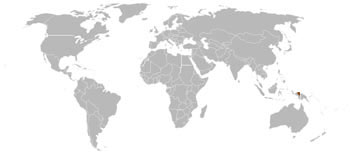
Sir David's Long-Beaked Echidna is found in the Cyclops Mountains in Papua. They live in mountain forests and they are believed to lead a solitary lifestyle.
Diet
Sir David's Long-Beaked Echidna mainly feed on earthworms.
Breeding
Little is known about reproduction in Long-Beaked Echidna but it is believed to be similar to that of the short-beaked echidna.
Predators
Humans are the main predators of Sir David's Long-Beaked Echidna.
Subspecies
There are no subspecies of the Sir David's Long-Beaked Echidna.
Interesting Facts
Sir David's Long-Beaked Echidna are also known as:
Sir David's Long-Nosed Echidna
Attenborough's Long-Beaked Echidna
Attenborough's Long-Nosed Echidna
Cyclops Long-Beaked Echidna
Cyclops Long-Nosed Echidna
Sir David's Long-Beaked Echidna is named in honor of Sir David Attenborough.
In the past this species has been thought to be extinct but evidence of its existence has recently been found. Find Out More>
Sir David's Long-Beaked Echidna has been included as one of the 10 species to be investigated by the Zoological Society of London Edge of Existence Programme in 2007.
Similar Animals
Eastern Long-Beaked Echidna
Western Long-Beaked Echidna
Short-Beaked Echidna
Duck-Billed Platypus
|