| Latin Name |
Gavia adamsii |
| Conservation Status |
Near Threatened |
| Location
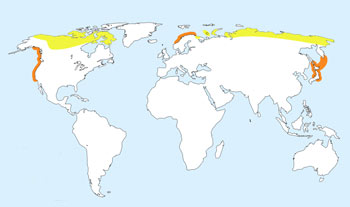
| Russia, Canada & Alaska |
| Colour |
See Below |
| Length |
76 - 97 cm (30 - 38 inches) |
| Wingspan |
135 - 160 cm (53 - 63 inches) |
| Weight |
4 - 6.5 Kgs (8.8 - 14.3 lbs) |
| Life Expectancy |
Up to - Yrs |
Main Characteristics
The White-Billed Diver is the largest member of the diver family. They have a length between 76 and 97 cms (30 - 38 inches), a wingspan between 135 and 160 cms (53 - 63 inches) and they weigh between 4 and 6.5 kgs (8.8 - 14.3 lbs).
During the breeding season White-Billed Divers have a black head, a black and white upperside and white underparts. Their non-breeding plumage is more drab and they have a white chin and foreneck. They have a yellowish bill which appears very slightly upturned.
Habitat
White-Billed Divers spend the breeding season in the Arctic in Russia, Canada and Alaska. During the winter months they can be found at sea, mainly off the coasts of Norway, western North America and the eastern coast of Asia.
Diet
White-Billed Divers are specialist fish eaters and they catch all of their prey underwater.
Breeding
Predators
Subspecies
There are no subspecies of the White-Billed Diver.
Interesting Facts
White-Billed Divers are also known as:
White-Billed Loon
Yellow-Billed Diver
Yellow-Billed Loon
The scientific name of the White-Billed Diver is named after the naval surgeon Edward Adams.
Similar Birds
Red-Throated Diver
Black-Throated Diver
Pacific Diver
Great Northern Diver
|