| Latin Name |
Viverra zibetha |
| Conservation Status |
Least Concern |
| Location
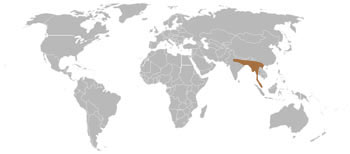
| S & S E Asia |
| Colour |
Greyish/Brown |
| Length |
86 cms (34 inches) |
| Tail |
33 cms (13 inches) |
| Weight |
5 - 11 Kgs (11 - 24 lbs) |
| Life Expectancy |
- |
Main Characteristics
Large Indian Civets have a body length of approximately 86 cms (34 inches), a tail length of 33 cms (13 inches) and they weigh between 5 and 11 kgs (11 - 24 lbs).
They are greyish/brown in colour with black and white stripes on their neck and black banding on their tail.
Habitat
Large Indian Civets can be found in grasslands, scrub and densely forested areas of south and south east Asia. They are solitary and are active at night.
Diet
Large Indian Civets mainly feed on insects, small mammals, birds, snakes, frogs, fruit and eggs.
Breeding
Large Indian Civets can produce up to two litters of 1 - 4 young each year. They youngsters are weaned at around 1 month old.
Predators
Humans are predators of Large Indian Civets.
Subspecies
Subspecies of the Large Indian Civet include:
Viverra zibetha ashtoni
Viverra zibetha hainana
Viverra zibetha picta
Viverra zibetha pruinosus
Viverra zibetha zibetha
Interesting Facts
Large Indian Civets are also known as:
Indian Civet
Similar Animals
Malayan Civet
Otter Civet
Small Indian Civet
Large-Spotted Civet
Malabar Large-Spotted Civet
Binturong
|