| Latin Name |
Viverricula indica |
| Conservation Status |
Least Concern |
| Location
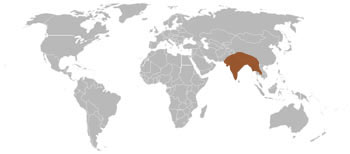
| South & South East Asia |
| Colour |
Grey/Tawny |
| Length |
75 cms (29.5 inches) |
| Tail |
45 cms (17.7 inches) |
| Weight |
2 - 4 Kgs (4.4 - 8.8 lbs) |
| Life Expectancy |
Up to 10 Yrs (in Captivity) |
Main Characteristics
Small Indian Civets have a body length of approximately 75 cms (29.5 inches) a tail length of approximately 45 cms (17.7 inches) and they weigh between 2 and 4 kgs (4.4 - 8.8 lbs).
They are grey or tawny in colour with rows of black spots on their body and stripes on their tail. Their legs, ears and muzzle are also black.
They are active at night and they are agile climbers.
Habitat
Small Indian Civets can be found in areas of thick vegetation and shrub in south and south east Asia.
Diet
Small Indian Civets mainly feed on rodents, lizards, small birds, insects and fruit.
Breeding
Small Indian Civets usually produce litters of 4 - 5 young.
Predators
Humans are predators of Small Indian Civets.
Subspecies
Subspecies of the Small Indian Civet include:
Viverricula indica atchinensis
Viverricula indica baliensis
Viverricula indica baptistae
Viverricula indica deserti
Viverricula indica indica
Viverricula indica klossi
Viverricula indica mayori
Viverricula indica muriavensis
Viverricula indica pallida
Viverricula indica schlegelii
Viverricula indica taivana
Viverricula indica thai
Viverricula indica wellsi
Interesting Facts
Small Indian Civets are also known as:
Lesser Indian Civet
Rasse
Similar Animals
Malayan Civet
Otter Civet
Large Indian Civet
Large-Spotted Civet
Malabar Large-Spotted Civet
Binturong
|