| Latin Name |
Cystophora cristata |
| Conservation Status |
Least Concern |
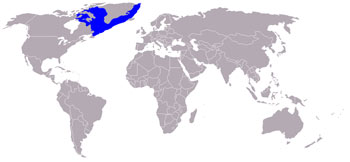
| Location
| N Atlantic to Arctic Ocean |
| Colour |
Grey with a dark pattern |
| Length |
2.5 - 2.7 m (8.2 - 8.9 ft) |
| Weight |
300 - 410 Kgs (660 - 900 lbs) |
| Life Expectancy |
30 - 35 Yrs |
Main Characteristics
Hooded Seals have a body length between 2.5 and 2.7 m (8.2 - 8.9 ft) and they weigh between 300 and 410 kgs (660 - 900 lbs). They have a dark coloured head and a grey coloured body with a dark blotchy pattern.
When males reach 4 years old a fleshy, trunk-like muzzle develops. They can inflate it to form a "hood" which doubles the size of their head, and they use it to intimidate rivals during the breeding season.
Habitat
Hooded Seals inhabit the North Atlantic to the Arctic Ocean.
Diet
Hooded Seals mainly feed upon fish but they will also feed upon squid and octopus.
Breeding
After a gestation period of 11 months, Hooded Seals give birth to a single pup. The pup is weaned at 4 - 5 days old which is the shortest weaning time of any mammal. They reach sexual maturity at 5 years of age.
Predators
Predators of hooded seals include polar bears and sharks.
Subspecies
Hooded Seals have no subspecies
Interesting Facts
Hooded Seal pups are weaned when they are 4 - 5 days old - the shortest time of any mammal.
Similar Animals
Leopard Seal
Crabeater Seal
Ross Seal
Weddell Seal
Bearded Seal
|