| Latin Name |
Equus zebra |
| Conservation Status |
Vulnerable |
| Location
| Africa |
| Colour |
Black or Dark Brown & White |
| Length |
2.1 - 2.6 m (6.9 - 8.5 ft) |
| Tail |
40 - 55 cm (15.7 - 21.6 inches) |
| Weight |
240 - 372 kgs (529 - 820 lbs) |
| Life Expectancy |
Up to 30 Yrs (in Captivity) |
Main Characteristics
Mountain Zebra have a body length between 2.1 and 2.6 m (6.9 - 8.5 ft), a tail length between 40 and 55 cms (15.7 - 21.6 inches) and they weigh between 240 and 372 kgs (529 - 820 lbs).
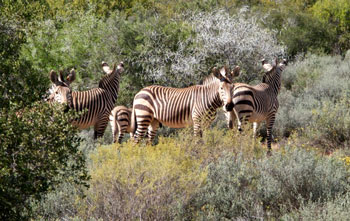
They have a distinctive black or dark brown and white striped pattern that is unique to each individual. The pattern continues through their short mane that stands upright and their belly is white. They are the only species of zebra to have a dewlap that hangs from their throat.
Mountain Zebras are good climbers and they have very hard, pointed hooves compared to other equids.
Habitat
Mountain Zebras can be found on the slopes and plateaus of the mountainous areas of South Africa and Namibia. During the winter months they inhabit lower elevations but during the summer they can be found at altitudes up to 2,000 m (6,562 ft).
Diet
Mountain Zebras feed on a variety of grasses, plants and browse.
Breeding
After a gestation period of 365 days, Mountain Zebras give birth to a single foal. The youngster is weaned at 10 months old and they become sexually mature at 3 - 6 years of age.
Predators
Predators of Mountain Zebras include lions, hyenas, leopards, cheetahs and african wild dogs.
Subspecies
Subspecies of the Mountain Zebra are:
Hartmann's Mountain Zebra
(Equus zebra hartmannae)
Cape Mountain Zebra
(Equus zebra zebra)
Interesting Facts
Similar Animals
Onager
Kiang
Grevy's Zebra
Plains Zebra
African Wild Ass
|